10 November 2026
/10 min read
Types of Logistics: Inbound, Outbound, Reverse and Third-Party Explained (2026 Guide)
When a business says "we have a logistics problem," the first question should be: which one? Late raw material, slow dispatch, messy returns and an overstretched in-house fleet are four different problems with four different fixes.
That is why understanding the types of logistics matters. Each type has its own flow, its own cost drivers and its own KPIs. In practice, most Indian businesses run several at once across rail, air and surface logistics, and the real skill is knowing which one is holding the business back.
This guide covers inbound, outbound, reverse and third-party logistics, with operational examples, finance context and a simple framework for deciding where to focus. It is written for operations heads, supply chain managers and finance leads.
What Are the Main Types of Logistics? An Overview
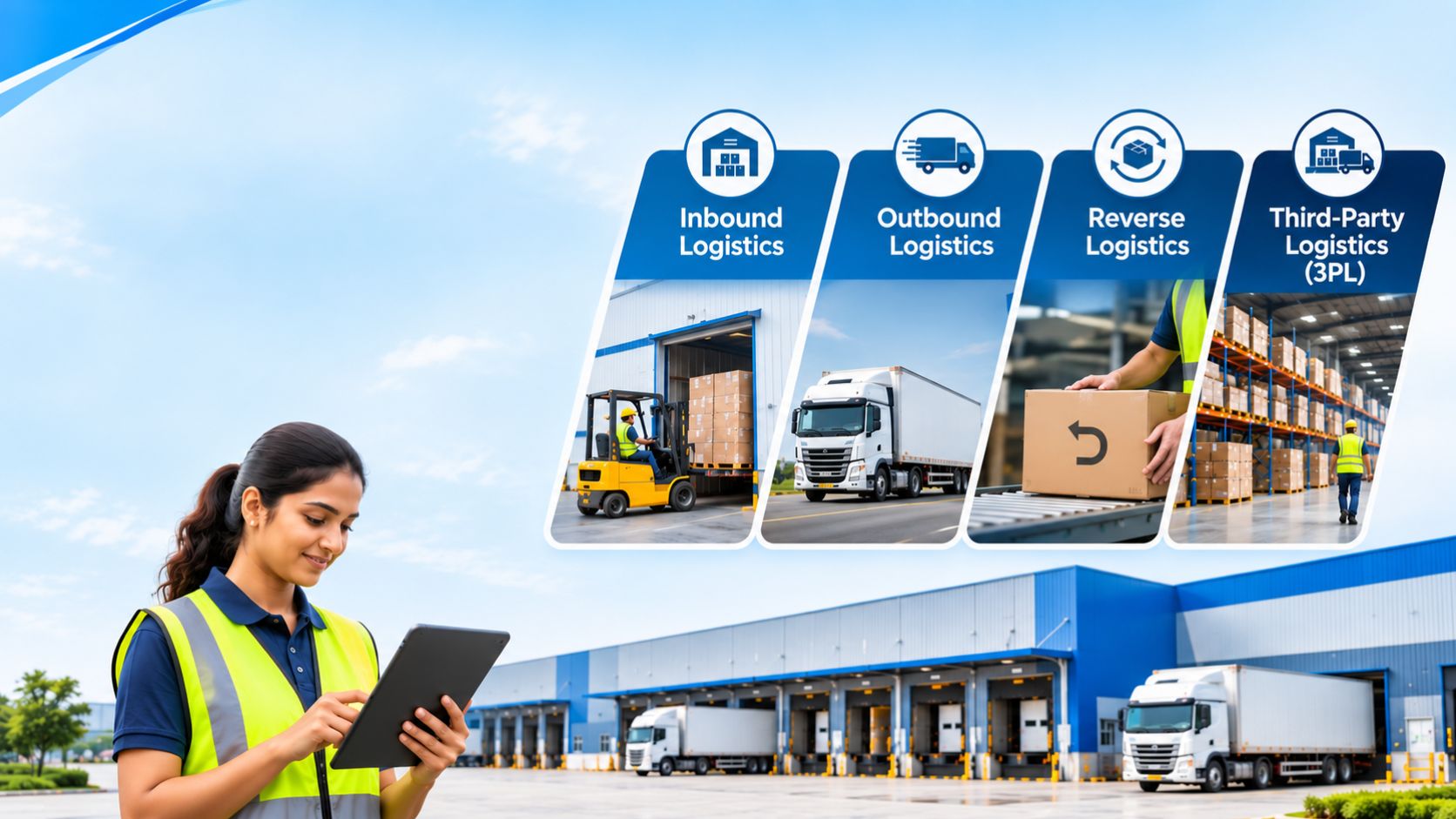
The four main types of logistics are inbound, outbound, reverse and third-party logistics. The first three describe the direction of goods. The fourth describes who runs the operation.
Type | Direction | Core question | Main cost drivers | Key KPI |
| Inbound | Supplier to your site | How do materials arrive reliably and cheaply? | Inbound freight, detention, receiving effort | Supplier on-time delivery |
| Outbound | Your site to customers | How do we deliver orders on time and in full? | Freight, packing, delivery failures | OTIF, cost per shipment |
| Reverse | Customer back to you | How do we recover value from returns? | Pickup, inspection, restocking | Return processing time |
| Third-party (3PL) | Any direction, outsourced | What should we run ourselves and what should we buy? | Service fees, contract terms | Service-level adherence |
Logistics is one part of a wider planning discipline, which we explain in our guide to Logistics Vs Supply Chain Management. Here, the focus stays on execution.
What Is Inbound Logistics?
Inbound logistics covers everything involved in bringing materials, components or stock from suppliers into your plant or warehouse. It includes sourcing coordination, inbound transport, receiving, inspection and put-away.
For a manufacturer, inbound problems are expensive because they stop production. A single missing component can idle a line.
For bulk, steady supply, ftl logistics gives dedicated capacity and predictable transit from supplier to plant. For smaller or irregular supply, consolidation and milk-run pickups often work better than many part-loaded trucks.
When a critical part is about to cause a stoppage, air cargo logistics can be a justified exception. The freight premium is usually far smaller than the cost of idle production.
Common challenges: supplier delays, vehicles waiting at the gate, documentation gaps for imported inputs and unpredictable lead times.
Finance angle: inbound freight is part of landed cost, and unreliable supply forces higher safety stock, which ties up working capital.
What Is Outbound Logistics?
Outbound logistics is the movement of finished goods from your warehouse to distributors, retailers or end customers. It includes order picking, packing, documentation, line-haul transport and final delivery.
This is the part customers see. A late or damaged consignment is judged as your failure, whoever carried it.
For planned replenishment between major hubs, a Delhi to Mumbai Rail parcel service can lower cost per kg compared with road, provided the longer transit window is acceptable. Road remains the flexible option for urgent and irregular orders.
The final stretch is usually the weakest link. Last mile delivery depends on address quality, delivery density and vehicle availability, and it is especially difficult outside the metros.
Common challenges: peak-season surges, cut-off time misses, failed deliveries and slow proof of delivery.
Finance angle: freight as a share of sales is a key margin lever, and slow proof of delivery delays invoice release and cash collection.
What Is Reverse Logistics?
Reverse logistics manages the flow of goods back from customers or the field: returns, repairs, replacements, recalls and recycling.
It is often under-managed because it looks like a cost with no revenue attached. In reality, how quickly a returned item is inspected, repaired or restocked decides how much of its value you recover.
Pickup is the operational starting point. For business customers, collecting a return is effectively door to door delivery in reverse, and it needs scheduling, tracking and clear condition checks to avoid disputes.
For pharma and food, reverse flows are also a compliance matter. Expired or recalled stock needs traceable documentation and controlled handling.
Common challenges: grading and inspection delays, return fraud, unclear responsibility for damage and long restocking cycles.
Finance angle: every day a returned item sits unprocessed is a day its value is not recovered, and credit notes issued before inspection can overstate losses.
What Is Third-Party Logistics (3PL)?
Third-party logistics (3PL) means outsourcing transport, warehousing or both to a specialist provider, instead of running them in-house.
A fourth-party arrangement goes further, with a lead provider managing the wider network and other vendors on your behalf. Businesses comparing 3PL and 4PL providers should look beyond price at technology, visibility, liability terms and the ability to scale with seasonal demand.
Outsourcing tends to work best when volumes are seasonal, when you lack capital for fleets or warehouses, or when you need modes you cannot easily build yourself. It converts fixed cost into variable cost, though exit costs and dependency are real trade-offs.
To compare providers, read our guide to the top 10 logistics company in India and our note on in-house logistics vs 3PL.
How to Choose the Right Type of Logistics Strategy for Your Business
Start with where the money leaks
Before picking a strategy, map your flows and quantify them. Useful numbers are freight cost as a percentage of sales, inventory days, supplier on-time rate, return rate and delivery failure rate. The type of logistics with the weakest numbers is where to focus first.
Decision guide by business situation
Manufacturers with production stoppages: fix inbound first. Supplier reliability and inbound lead times matter most.
Distributors and D2C brands with delivery complaints: fix outbound. Focus on mode mix, carrier performance and proof of delivery.
High-return categories such as electronics and apparel: invest in reverse logistics. Faster grading recovers more value.
Seasonal or capital-light businesses: consider outsourcing to a 3PL, starting with one lane and a pilot.
Pharma, food and high-value shippers: build specialised handling and a plan for urgent movement. Air to Air Services connect airports directly and suit time-critical consignments.
Most businesses end up with a hybrid: some activities in-house, others outsourced. The goal is not to use every type of logistics but to put effort where it changes cost, cash flow or customer experience the most.
Conclusion
The types of logistics are not competing options. They are different flows in the same business, and each fails in its own way. Map them, measure them and fix the weakest one first.
If you want an outside view on your freight setup, Ethics Express can review your lanes across road, rail and air and share a practical opinion on mode and cost.