08 June 2026
/5 min read
Rail Parcel vs Road Freight: Which Is Cheaper for Delhi–Mumbai Shipments?
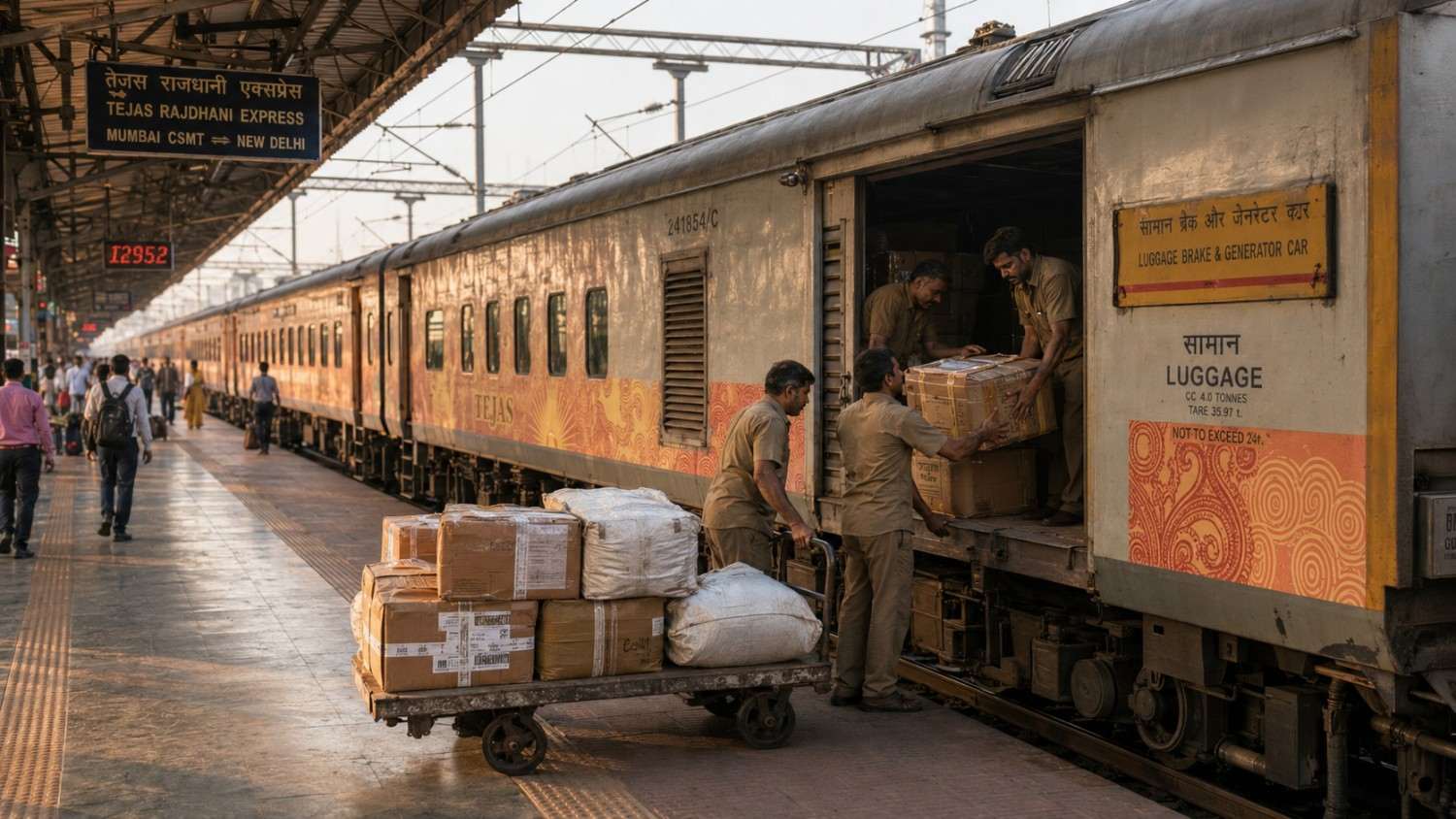
If your business moves goods between Delhi and Mumbai, the decision has often been made by habit: book a truck. It is familiar, it goes door to door, and it works. On a corridor as long and as busy as this one, though, that default deserves a second look, because the economics are not always what they appear.
The short version is this. For the long stretch between the two cities, rail is generally the more economical way to carry regular, high-volume freight, and on a fast train the line-haul can be quicker than a truck as well. Where road stays ahead is reach: it picks up and delivers at the door, with nothing in between. For most shippers, the most cost-effective and dependable approach is not one mode or the other. It is rail for the long middle leg and road for the first and last mile. What follows explains how the two compare, and where each genuinely makes sense.
Why the Delhi–Mumbai corridor is worth analysing
This is one of the densest freight lanes in the country, roughly 1,400 kilometres of steady, two-way goods movement. That density is precisely what makes the comparison meaningful. On a thin rural route, rail may barely run and the choice makes itself. Here, both modes are strong: there are fast, frequent trains and well-equipped terminals at both ends, alongside a road network that continues to improve.
When a corridor offers real options on both sides, the question stops being about what is available and becomes a matter of cost, transit time, and how far the goods must travel beyond the terminal. That is a comparison worth doing on its merits rather than out of routine.
How rail parcel movement works
Rail parcel is not the same as chartering a full goods train. Parcels move in dedicated parcel vans attached to passenger trains, and the major terminals are built to load and unload them efficiently.
The model that matters most for a business is the dedicated van. Rather than competing for space shipment by shipment, an operator can reserve an entire parcel van on a specific train. That secures committed capacity and a fixed, scheduled departure, so goods leave on a known train at a known time and arrive on a predictable clock. The practical point worth understanding is that a dedicated van works best when it is consistently well filled, because its economics depend on using the reserved capacity rather than leaving it idle.
How road freight works on the same lane
Road freight is the model every shipper knows. You book a truck, either as a full load or as a shared part load, and it travels from your dock to the destination dock with no terminal in the middle and no booking window to catch.
The trade-off is time and cost over long distances. A truck on this route generally takes around two to three days once driving-hour limits, rest stops, and traffic are accounted for, although ongoing expressway improvements are gradually reducing that. And because road carries the full weight of fuel, tolls, and driver time across the entire distance, the cost per kilometre is comparatively high on a haul this long.
The cost question, answered honestly
This is where the corridor surprises people, so it is worth being precise about what actually drives the numbers rather than quoting a single rate.

[IMAGE HERE — infographic-1-cost.png. Alt text: "Relative cost of rail versus road freight over a long corridor"]
Rail earns its cost advantage on long distances by moving consolidated volume efficiently over the trunk, spreading the cost of the journey across a large, reserved capacity. Road carries the full cost of fuel, tolls, and labour over every kilometre, which is why its per-unit cost climbs as the distance grows. As a general rule, rail comes out a meaningful margin lower than road for long-haul movement of regular freight, and the longer the corridor, the wider that gap tends to be. Over 1,400 kilometres, that difference stops being marginal and becomes a real line in the logistics budget.
Two honest caveats keep this realistic. First, a rail movement is terminal-to-terminal, so the true door-to-door cost has to include the short road legs at each end; even with those added, on a corridor this long the combined figure usually still lands below pure road. Second, the actual saving in any given case depends on the weight and volume of the shipment, how fully the rail capacity is used, and how close the pickup and delivery points sit to a terminal. Those variables are why a proper quote always beats a rule of thumb.
The transit-time reality
The bigger surprise is speed. Rail is often assumed to be the slower option, and on this corridor that assumption does not hold for the trunk leg. A fast train such as the Tejas Rajdhani covers the route overnight. A truck completing the same journey in two to three days cannot match that on the long stretch.

[IMAGE HERE — infographic-2-transit.png. Alt text: "Delhi–Mumbai transit time: rail overnight run versus road two to three days"]
It is important to state this fairly. That overnight figure is the train's run between terminals. The full door-to-door time also includes loading and unloading at the parcel terminals and the short road legs at each end. Even after allowing for those, a well-organised rail movement on this corridor is usually time-competitive with road, and frequently quicker. What rail cannot do is begin at your warehouse and finish at your customer's gate on its own. That is where road remains essential.
Where each mode genuinely wins
None of this makes road obsolete, and it would be misleading to suggest otherwise.

[IMAGE HERE — infographic-4-wins.png. Alt text: "Where rail parcel wins and where road freight wins"]
Road wins wherever reach and flexibility matter more than trunk cost. It runs straight from origin to destination with no transfer, which suits goods you would rather not handle more than once. It moves on your schedule instead of a train's timetable. It is the better choice for shorter distances, for oversized or awkward consignments, and for any pickup or delivery point that is not conveniently near a parcel terminal. And for a one-off urgent shipment, where arranging a rail leg adds coordination, a truck is simply the simplest path.
Rail parcel and road freight at a glance
| Factor | Rail Parcel | Road Freight |
|---|---|---|
| Cost over long distances | Generally lower for regular volume | Generally higher on long hauls |
| Trunk transit (Delhi–Mumbai) | Overnight train run (~15–16 hrs) | Typically around 2–3 days |
| Reach | Terminal to terminal | Door to door |
| Schedule | Fixed daily departure | Flexible |
| First & last mile | Needs a road leg at each end | Built in |
| Best suited to | Regular, high-volume, metro-to-metro | Short hauls, door delivery, flexible timing |
The setup that works for most businesses
For Delhi–Mumbai specifically, the most cost-effective and reliable arrangement for regular shippers is usually a combination. Rail carries the long trunk between the cities, where it is economical and quick, and road handles the first mile from your facility to the originating terminal and the last mile from the destination terminal to the customer.

[IMAGE HERE — infographic-3-flow.png. Alt text: "Three-step rail-led movement: first mile by road, rail trunk haul, last mile by road"]
Built well, this hybrid beats pure road on cost and beats pure rail on reach. The decision then comes down to a few practical questions: how far your pickup and delivery points sit from a terminal, how regular and heavy your volumes are, and how predictable the arrival needs to be. The more your freight looks like steady, high-volume movement between the two metros, the more a rail-led setup pulls ahead.
How Ethics Express approaches the corridor
This combination is difficult to deliver unless a provider operates both modes, which is the case here. Ethics Express runs a dedicated rail parcel service on the Delhi–Mumbai corridor, operating on the Tejas Rajdhani with a dedicated 24-tonne parcel van in each direction on a daily round-trip schedule, so capacity is committed and departures run to a fixed clock. Alongside it sits our road network for full and part truck loads, which means the first and last mile can be designed around the rail leg rather than added as an afterthought. It is backed by a team with over 20 years of experience in railway parcel services across India.
You can see the rail service in detail on our Rail Parcel page, explore the full range of services, or talk to our team about your own lanes and volumes.
Frequently asked questions
1. Is rail cheaper than road for Delhi–Mumbai?
For the long trunk leg, it usually is for regular, high-volume freight, and the advantage tends to widen over a corridor this long. The exact saving depends on weight, volume, how fully the capacity is used, and the short road legs at each end, so a proper quote is always more accurate than a general rule.
2. How long does a rail parcel take from Delhi to Mumbai?
A fast train such as the Tejas Rajdhani runs the corridor overnight, with a scheduled time of roughly 15 to 16 hours. Total door-to-door time also includes terminal handling and the road legs at each end, but it generally compares well with the two to three days a truck takes.
3. What is a parcel van?
It is a dedicated railway van for parcels, attached to a passenger train. An operator can reserve a whole van on a specific train to secure committed capacity and a fixed daily departure.
4. Can rail parcel deliver door to door?
Not on its own. Rail moves terminal to terminal, so it is paired with a short road leg at each end to complete the door-to-door journey. That combination is the practical way to use it.
5. What kind of goods suit rail parcel?
Regular, packaged freight moving between the two metros is the natural fit. Some categories of goods are restricted on rail parcel, so it is sensible to confirm the commodity before booking.
6. Is rail parcel reliable for business shipments?
With a dedicated van on a scheduled train, capacity is reserved and the arrival time is predictable, which is often more consistent than road transit that is exposed to traffic and driving-hour limits.
Shipping regularly between Delhi and Mumbai and want to know what a rail-led setup would cost for your freight? Talk to our team and we will work out the most cost-effective mix for your shipments.