08 June 2026
/5 min read
Cold Chain and GDP Compliance: Moving Pharma Without Breaking the Temperature Chain
A vaccine vial doesn't announce when it has gone bad. It looks exactly the same after a four-hour temperature excursion as it did leaving the plant. That's what makes pharmaceutical logistics so unforgiving: the failure is invisible until a patient, a regulator, or an audit finds it. Get the temperature chain wrong, and you aren't just risking a delayed delivery. You're risking a degraded batch, a product recall, and a serious compliance problem.
Two ideas sit at the centre of moving medicines safely. The cold chain is the unbroken, temperature-controlled journey a product takes from the manufacturer all the way to the patient. GDP, or Good Distribution Practice, is the set of rules that says how that journey has to be controlled, documented, and proven. One is the physical reality; the other is the standard you're held to. This piece walks through both, where things break, and what a compliant operation actually looks like in India today.
What the cold chain really means
The cold chain isn't a single fridge or a single truck. It's every link between production and patient where temperature has to be held within a defined band, and it's only as strong as its weakest moment. A product can sit perfectly at the plant, travel perfectly for 600 kilometres, and still be ruined in the ten minutes it spends on a hot loading dock waiting for the next vehicle.
Most pharmaceutical products fall into one of a few temperature zones. Refrigerated products sit at 2 to 8 degrees Celsius, which covers most vaccines and many biologics. Controlled-room or ambient products travel at 15 to 25 degrees. Frozen products need roughly minus 18 to minus 25 degrees, and a small but growing set of advanced therapies need ultra-cold conditions colder still. Each band has its own equipment, its own packaging, and its own margin for error, and the margin is usually narrow.
What GDP is, and why it isn't optional
Good Distribution Practice is the global benchmark for how medicines are stored, handled, and transported, and it's defined by the World Health Organization. In India, the principles are codified in Schedule M of the Drugs and Cosmetics Rules and enforced through the Central Drugs Standard Control Organisation, with state drug authorities increasingly active as Indian companies push deeper into regulated export markets like the US, UK, and EU.
The reason it matters right now is timing. The revised Schedule M came with a hard compliance deadline of 1 January 2026, and it lands heaviest on smaller manufacturers who have run on legacy, fragmented setups for years. For a lot of the industry, GDP has moved from "good to have" to "prove it or you don't ship."
In practice, GDP covers temperature control, documentation and traceability, trained personnel, validated equipment, and a defined way of handling things when they go wrong. It applies to everyone who touches the product, which is why the responsibility flows down to logistics partners. A manufacturer's compliance is only as good as the carrier it hands the boxes to.
The weakest link: temperature excursions
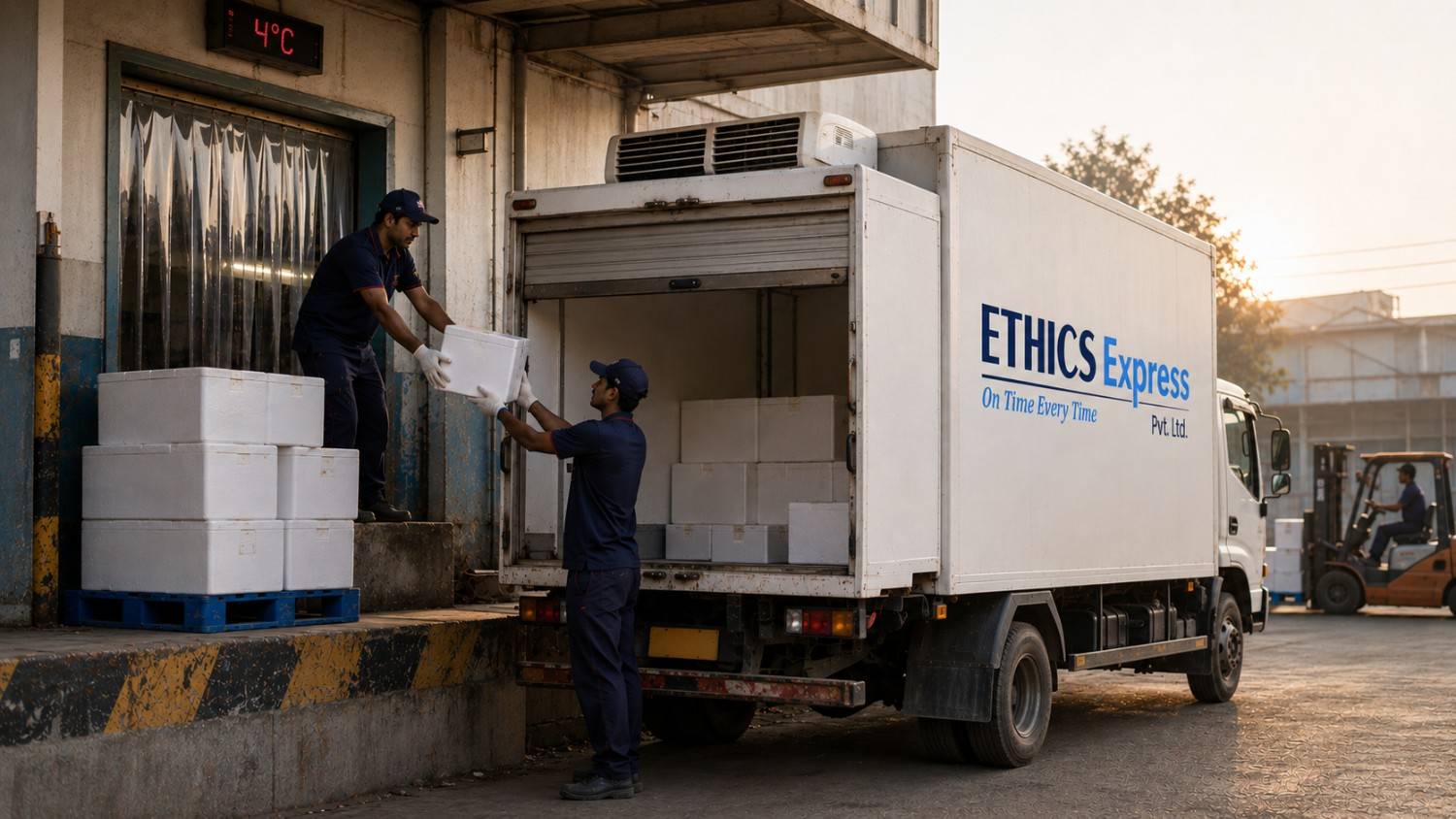
A temperature excursion is any moment the product drifts outside its approved range. It's the single biggest risk in the whole chain, and it rarely happens on the open road. It happens in the gaps: during loading and unloading, when a shipment changes hands, at the last mile into a hospital or chemist, and during the power cuts that still interrupt parts of the Indian grid.
The consequences scale fast. A short excursion might shorten shelf life. A serious one can destroy efficacy entirely, force a recall, trigger regulatory penalties, and do lasting damage to a brand's reputation with both regulators and customers. And because the damage is invisible, the only protection is proof: a continuous, documented record showing the temperature never broke.
What a GDP-compliant cold chain actually requires
Compliance isn't a sticker. It's a set of operational habits that have to hold up under audit.
It starts with validated equipment. Reefer vehicles, insulated packaging, and cold storage all have to be qualified and tested under real conditions, not assumed to work. On top of that sits continuous temperature monitoring using calibrated data loggers, so there's an unbroken record for every shipment rather than a spot check at each end. Then come the documented standard operating procedures, the chain-of-custody records that track who held the product and when, and trained staff who understand that a pharma carton is not the same as a furniture carton. Finally, there has to be a clear excursion-response plan, so that when a deviation happens, someone knows immediately whether the product can still be released or has to be quarantined.
Miss any one of these and the chain has a hole, even if the trucks themselves are spotless.
From "read it later" to "fix it now"
For years, temperature monitoring meant a passive USB logger tucked into the load and read only after the shipment arrived. If something had gone wrong in transit, you found out too late to do anything about it. The cargo was already lost; all the logger did was confirm it.
The shift now underway, sometimes called Cold Chain 4.0, is toward active monitoring: IoT sensors that report temperature continuously and raise an alert the moment a reading drifts, while the truck is still on the road and intervention is still possible. The impact is measurable. In 2025 pilot deployments, real-time IoT tracking reduced pharmaceutical shipment excursions from around 1.93 percent to 0.3 percent. For a high-value, compliance-bound product, that gap is the difference between a saved batch and a written-off one.
The Indian picture in 2026
India sits in an unusual position. It's one of the world's largest suppliers of generic medicines and vaccines, which means a vast volume of temperature-sensitive cargo moves across the country and out of it every single day. The cold chain logistics market here is large and growing, projected at roughly USD 24.85 billion in 2026, with the pharma sub-segment among the fastest-expanding parts of it.
But the operating conditions are genuinely hard. Manufacturing is concentrated in clusters like Hyderabad, Ahmedabad, and the Baddi belt in Himachal Pradesh, while demand is spread across thousands of pincodes, many of them rural and poorly served. Add high ambient heat for much of the year, an unreliable power supply in places, energy costs that eat a large share of operating expense, and a still-fragmented sector, and you have a chain with a lot of places to break. The Schedule M deadline only sharpens the pressure: the infrastructure that quietly got by before now has to be validated, monitored, and documented.
How Ethics Express approaches pharma cold chain
For pharmaceutical clients, the requirements are non-negotiable, and Ethics Express works to them directly: cold chain logistics built around GDP-compliant operations, with real-time temperature monitoring across the journey. The focus is on the three things that decide whether a pharma shipment is a success or a liability, which are holding the temperature range, meeting regulatory expectations, and protecting product integrity from origin to destination.
You can see how this fits within the wider range on our industries and services pages, or reach out directly to talk through your specific temperature profiles and lanes.
Frequently asked questions
1. What is GDP in pharmaceutical logistics?
GDP stands for Good Distribution Practice, the WHO-defined standard for storing, handling, and transporting medicines so their quality and safety are preserved. In India it's codified in Schedule M of the Drugs and Cosmetics Rules.
2. What temperature ranges does a pharma cold chain use?
The common bands are 2 to 8 degrees Celsius (refrigerated), 15 to 25 degrees (controlled ambient), and roughly minus 18 to minus 25 degrees (frozen), with ultra-cold ranges for certain advanced therapies.
3. What is a temperature excursion?
It's any period during which a product moves outside its approved temperature range. Even a short excursion can affect quality, and a serious one can make the product unusable.
4. Is GDP compliance mandatory in India?
Yes. The principles are enforced under Schedule M, overseen by CDSCO, and the revised rules carried a compliance deadline of 1 January 2026. Compliance is also expected by regulated export markets.
5. How is temperature monitored during transit?
Through calibrated data loggers, and increasingly through active IoT sensors that report continuously and send real-time alerts if a reading drifts, allowing intervention before the cargo is lost.
6. What happens if the cold chain breaks?
The affected stock typically has to be quarantined and assessed against the product's stability data. Depending on the severity, it may be released, downgraded, or written off, and the deviation has to be documented either way.
Moving temperature-sensitive medicines and want a partner who treats compliance as the starting point, not an afterthought? Talk to our team about your cold chain requirements.