03 July 2026
/8 min read
Air Cargo vs Rail Parcel vs Road Freight: A Complete Cost & Speed Comparison
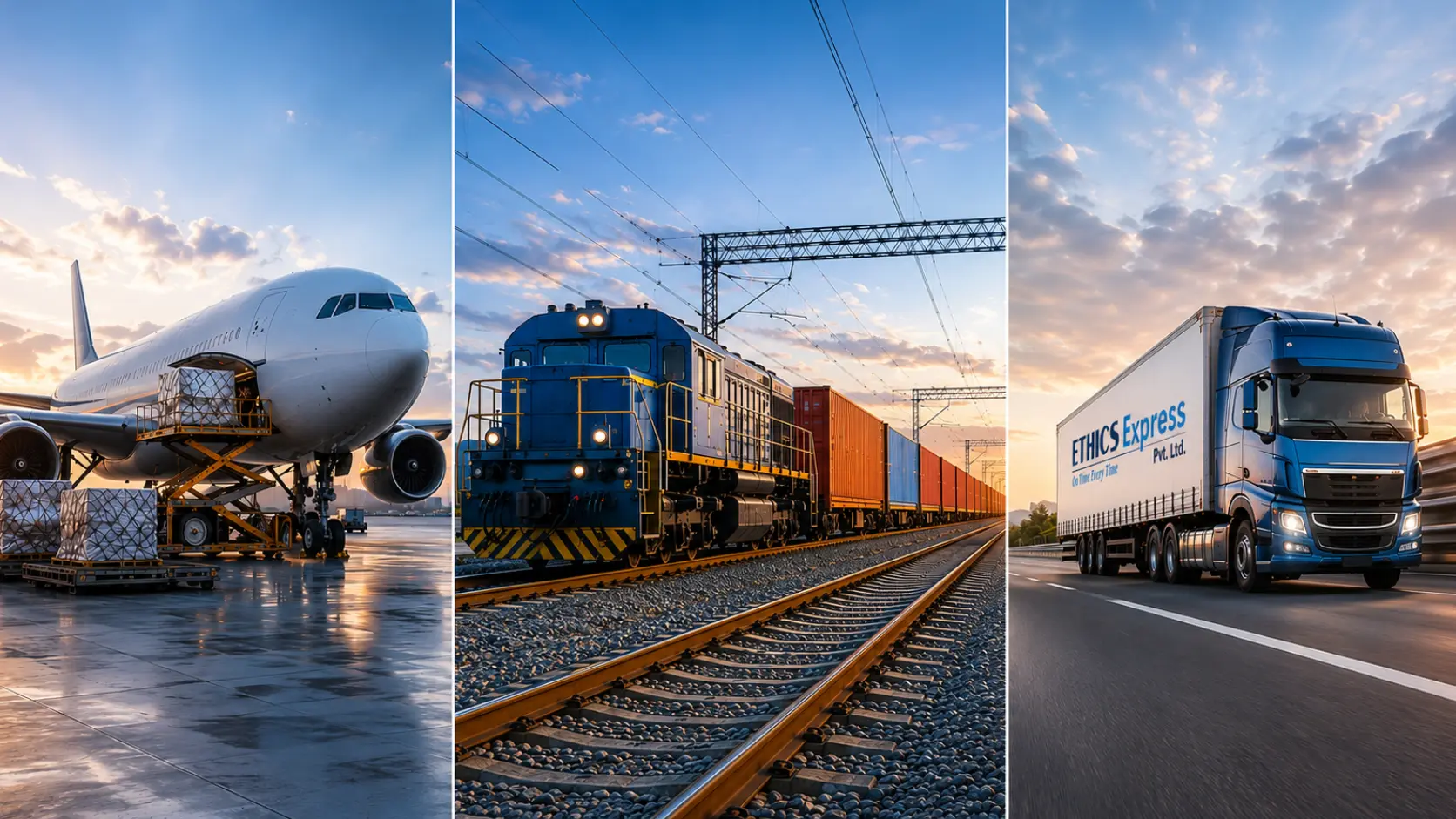
Choosing the right freight mode can be the difference between a shipment that arrives on time and on budget — and one that eats into your margins or disappoints your customer. Businesses shipping across India today have three primary options: air cargo, rail parcel, and road freight. Each comes with its own trade-offs in cost, speed, capacity, and reliability.
If you've ever asked "should I ship by road, rail, or air?" — this guide breaks down exactly how these three modes compare, so you can match your shipment to the right mode based on what matters most for your business: speed, cost, or volume.
Quick Comparison: Air vs Rail vs Road Freight
Factor | Air Cargo | Rail Parcel | Road Freight |
| Speed | Fastest (hours to 1-2 days) | Moderate (1-3 days) | Slowest for long-haul (2-5+ days) |
| Cost per kg | Highest | Lowest for bulk/long-distance | Moderate, scales with distance |
| Best for | Urgent, high-value, lightweight goods | Bulk, non-urgent, long-distance freight | Flexible volumes, door-to-door needs |
| Capacity | Limited by aircraft space | High (bulk parcel capacity) | Flexible (FTL/PTL options) |
| Weather sensitivity | High | Low | Moderate |
| Door-to-door delivery | Requires road leg on both ends | Requires road leg on both ends | Native door-to-door capability |
1. Air Cargo: When Speed Is Non-Negotiable
Air cargo is the fastest freight mode available, often moving shipments within hours between major cities. It's the default choice when a delay would cost you more than the premium freight rate.
Air cargo makes sense when:
- You're shipping time-sensitive goods — pharmaceuticals, perishables, or urgent spare parts
- The shipment is high-value and low-weight (electronics, documents, samples)
- You need cross-country or international delivery in the shortest possible window
- Reliability of transit time matters more than cost per kg
The trade-off: Air freight typically costs significantly more per kilogram than rail or road, and capacity is limited by aircraft cargo space, which can create bottlenecks during peak seasons or on less-connected routes.
2. Rail Parcel: The Cost-Efficient Option for Bulk, Long-Distance Freight
Rail parcel transportation is often the most overlooked freight mode — but for the right shipment profile, it's hard to beat on cost. Moving freight by rail is particularly efficient on high-volume, long-distance corridors like Delhi to Mumbai, where large parcel volumes can be consolidated into a single rail movement.
Rail parcel makes sense when:
- You're shipping large volumes that don't require next-day delivery
- Your route runs along a well-connected rail corridor
- You want to reduce cost per kg without sacrificing too much on transit time
- Your goods are not highly time-sensitive but still need predictable delivery windows
The trade-off: Rail parcel requires a road leg on both ends (pickup to the rail terminal, and terminal to final delivery), and route coverage is limited to existing rail freight corridors — it's not a door-to-door solution on its own.
3. Road Freight (FTL/PTL): The Most Flexible, Door-to-Door Option
Road freight remains the backbone of Indian logistics because of its unmatched flexibility. Whether you need a Full Truck Load (FTL) for large, dedicated shipments or a Part Truck Load (PTL) for smaller volumes, road transport can reach nearly any pin code in the country — including areas with no direct rail or air connectivity.
Road freight makes sense when:
- You need genuine door-to-door delivery without transfer between modes
- Your shipment volume doesn't justify a full air or rail movement
- You're shipping to regional or last-mile destinations not served by rail or air cargo
- You want flexibility to scale between FTL and PTL depending on order volume
The trade-off: For long-distance routes, road freight transit times are generally longer than rail, and costs can rise on routes with high fuel/toll expenses or low return-load availability.
How to Choose the Right Freight Mode: A Simple Framework
Ask yourself these three questions:
- How urgent is the shipment? Hours matter → Air. A few days is fine → Rail or Road.
- What's the shipment volume and weight? Small, light, high-value → Air. Large, bulk, long-distance → Rail. Flexible/variable → Road (FTL/PTL).
- Does it need true door-to-door delivery, or can it move through a hub? Door-to-door with no transfers → Road. Comfortable with a rail/air leg plus a road leg on either end → Rail or Air.
Many businesses don't rely on a single mode — they use a multimodal strategy, shipping bulk, non-urgent inventory via rail to cut costs, while reserving air cargo for urgent replenishment or high-priority orders, and using road freight to fill last-mile and regional gaps.
Real-World Example: Delhi to Mumbai Shipments
The Delhi–Mumbai corridor is one of India's busiest freight routes, and it's a useful case study for this comparison:
- Air cargo gets a shipment there in hours, but at a premium — ideal for urgent B2B replenishment or pharma cold-chain goods.
- Rail parcel is typically the most cost-effective option for bulk shipments on this route, especially where a 1-3 day transit window is acceptable.
- Road freight (FTL/PTL) offers flexibility and true door-to-door service, useful when the destination isn't near a rail terminal or when shipment volume doesn't justify a full rail movement.
Conclusion
There's no single "best" freight mode — the right choice depends on your shipment's urgency, volume, and destination. Air cargo wins on speed, rail parcel wins on cost-efficiency for bulk long-distance freight, and road freight wins on flexibility and true door-to-door reach.
At Ethics Express, we help businesses move freight the smart way — combining rail parcel, air cargo, and road freight (FTL/PTL) into a single logistics strategy tailored to your shipment volume, timeline, and budget. Whether you need a dedicated Delhi-Mumbai rail parcel solution or a full multimodal freight plan, our team can help you choose the mode that fits your business best.
Frequently Asked Questions (FAQ's)
Which freight mode is cheapest for long-distance shipping in India? Rail parcel is generally the most cost-effective option for large, non-urgent shipments over long distances, particularly on well-connected corridors like Delhi–Mumbai.
Which is faster — air cargo or rail parcel? Air cargo is significantly faster, often delivering within hours versus 1-3 days for rail, but at a much higher cost per kilogram.
Can I combine multiple freight modes for one shipment? Yes — many businesses use a multimodal approach, splitting inventory across air, rail, and road based on urgency, cost sensitivity, and destination, to optimize both cost and service levels.
Is road freight only useful for short distances? No. Road freight (especially FTL) is used for both short and long-haul shipments, particularly where door-to-door delivery or last-mile reach to non-rail-connected areas is required.